the wet witch
Cartes Postales from GreeceThe wet witch is a woman living apart from ordinary village life in a cave cut into the island’s rocks. Local stories surround her with strange powers, but Antigoni’s encounter reveals a person who can be approached, spoken to, and painted. Her significance lies both in the contrast between rumor and direct contact and in the portrait she inspires: an image that later exposes the distance between Antigoni’s artistic world and Christos’s expectations.
Cave Dweller and Local Legend
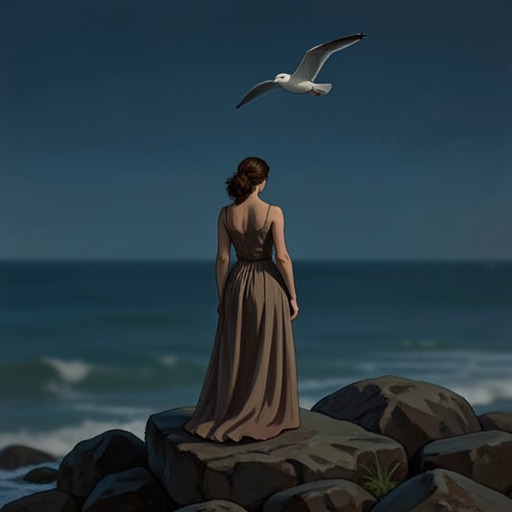
The wet witch lives behind a bright blue door built into a rocky cliff, a door that resembles the entrance to a house but opens into a cave. Antigoni comes upon it while walking toward the sea, in a direction opposite to the one she had taken during the preceding weeks. The nearby little church and castle ruins had already appeared repeatedly in Antigoni’s landscape paintings; the cave and its inhabitant draw her attention away from familiar scenery toward a human subject.
Christos had warned Antigoni about the cave’s resident. The surrounding island is described as so rich in water that moisture seeps from stone and leaves house walls dripping. In the local account, the cave floor is puddled, and the wet witch needs no drink because she absorbs moisture through her skin. Stories also claim that she lives on raw fish gathered from the waves and can either cure or curse people. These explanations make her seem less like an ordinary neighbor than a figure shaped by the landscape itself, though the account presents them as things people say, not as established facts.
The villagers’ response to her is divided between avoidance and exchange. Most people keep away, while a small number of fishermen bring her tiny marida that they cannot sell. They hope the gifts will earn them time inside her cave. Such transactions hint at a limited connection to the surrounding community: she remains an outsider, but not entirely beyond its reach. Rumor fills the gaps left by that distance, turning her secluded life into a subject for speculation.
Antigoni’s Encounter
The cave door suddenly opens as Antigoni passes, and a woman rushes out in visible distress, shouting and waving her arms. Antigoni steps back and tries to reassure her. The woman’s alarm passes; Antigoni notices that her face is finely shaped, with features in proportion. Rather than treating the encounter as confirmation of the frightening stories, Antigoni asks whether the woman lives there. The woman nods.
The exchange is brief but marks a difference between the wet witch’s public reputation and her presence in a face-to-face meeting. She observes that few women stop to speak with her. Antigoni thinks she had no choice in the encounter, yet answers politely and continues on her way. The meeting does not immediately become a friendship, but it leaves Antigoni with a particular image she cannot dismiss: the woman’s face haunts her through the day, appearing to her as powerful and wild. Antigoni wants to paint it.
The Portrait and Its Making
The following morning, Antigoni returns to the cave. A man is coming out as she approaches, but she gathers the courage to knock. From inside, the wet witch assumes that someone has come for fish and says she does not need any that day. Antigoni explains who she is and asks to paint her. After some time, the woman opens the door only a crack, then allows Antigoni to enter for a short while.
The conditions make the sitting difficult. The cave is almost dark, and Antigoni works quickly, sketching the woman’s face so she can finish the painting at home. Her hands are damp, and the pencil slips from her fingers. In the shadows, the wet witch seems both sinister and beautiful to the artist. That double impression becomes central to the portrait: it does not settle for the villagers’ fearful image of her, nor does it erase the strangeness that first drew Antigoni’s attention.
For Antigoni, painting the wet witch is part of a broader return to portraiture. After loneliness had driven her to paint landscapes, she found her sister Ismini’s picture among her work and remembered that her real talent lay in painting people’s likenesses. The cave encounter gives that renewed impulse a subject. Antigoni’s attention shifts from views she has already painted to a woman whom others mostly avoid, and the act of making the portrait depends on the brief permission the wet witch grants her.
The Painting and Christos’s Response
When Christos returns, Antigoni welcomes him, but a formality remains between them: they had hardly known each other before he left and must become acquainted again. In the dining room, he finds a group of portraits rather than the family images he expects. Among them is Antigoni’s painting of the wet witch, transformed by the artist’s imagination into a striking, unconventional figure. Christos also sees portraits of a priest, a couple, and a rugged fisherman; the subjects meet his gaze from the paintings, which appear vivid and almost alive.
Christos does not recognize the accomplishment Antigoni has made. Instead, he asks where the family portraits are and what she has done with them. The wet witch’s portrait thus matters beyond its subject: it belongs to Antigoni’s independent body of work, which Christos encounters but does not value as she does. A woman whom the village turns into a legend becomes, through Antigoni’s art, one of the faces that makes the difference between them visible.